
Charleston Criminal History Checks
Charleston has the clearest city-level records profile in the Franklin County research because the police department and district court pages publish specific contacts and payment routing. A Charleston check should begin with the city office when the event was handled by Charleston Police, then move to the district court for citations and misdemeanors, and finally to county or state systems when booking, felony, or statewide repository records are involved.
- Start with Charleston Police Department for city incident reports, local police questions, and report-copy availability.
- Request an incident report by giving the date, location, parties, and report number if available; the official page states copies are $10 per report.
- Check Franklin County District Court, Charleston Division, for city citations, misdemeanors, ordinance matters, traffic cases, and payment questions.
- Use the Franklin County jail roster, sheriff, and Circuit Clerk if the Charleston event involved booking, felony filing, or circuit-court activity.
- Use Arkansas State Police criminal-history channels for an official statewide record tied to fingerprints and repository reporting.
Charleston PD Report Copies Cost $10
The Charleston Police Department page is unusually direct about report copies. It states that copies of incident reports are available for $10 per report. That fee should be treated as a Charleston Police fact, not a countywide rule for the sheriff, Ozark Police, Altus matters, or the Franklin County courts. A requester should still confirm the current fee, accepted payment methods, and whether the report is releasable before going to the office.
The fee applies to police incident-report copies, not to court-file copies. If the record needed is a docket sheet, plea, disposition, judgment, warrant, or payment history, the better contact is Franklin County District Court, Charleston Division, or the Circuit Clerk if the case is at circuit level.
Records at the Charleston Police Department
Charleston Police Department is listed at 1418 East Main Street, Charleston, AR 72933, phone (479) 965-7600. The official page names Chief Billy Atchley and Detective Johnathan Anderson. It also gives an after-hours route: after 5 PM, callers are directed to (479) 667-4127, the Franklin County Sheriff's Office number. That after-hours routing is important when a records question overlaps with an active call, custody issue, or county jail booking.
The department page also links to the Arkansas Crime Information Center sex offender registry and points readers to district-court payment options. Those links do not turn the police department into a complete criminal-history repository. Charleston Police is the better source for city incident reports and local police records, while court cases, jail custody, and statewide criminal-history records live in separate systems.
The assigned source image comes from Charleston's official police page, the city-specific record source used for this section.
After 5 PM Calls Route to Sheriff
Charleston's after-hours instruction is a useful example of how city records and county operations meet. The police page directs after-5-PM calls to the sheriff at (479) 667-4127. That does not mean every Charleston police report is a sheriff record. It means urgent or after-hours law-enforcement contact may be handled through the county line, while report copies and department-specific records still route back to Charleston Police when the office is open.
For a current custody question, the sheriff or jail roster may be the fastest route. For a completed incident report, call Charleston Police. For the court result, call the Charleston district-court clerk or search the state court system. Keeping those channels separate avoids treating a dispatch or after-hours phone route as proof that the sheriff holds every city document.
Booking and Arrest Records in Charleston
A Charleston arrest may begin with Charleston Police and then appear in the Franklin County jail roster if the person is booked into county custody. The research found roster examples showing arrests by Charleston Police Department, Franklin County Sheriff's Department, and Arkansas Probation Parole. That confirms the roster is a county custody tool that can include multiple arresting agencies, not a Charleston-only arrest log.
When the arresting-agency field says Charleston Police Department, the incident-report copy question belongs with Charleston Police. Booking status, release information, and jail custody details belong with the sheriff or jail roster. Whether prosecutors filed a charge is a court question, usually checked through Search ARCourts or the Franklin County District Court, Charleston Division, unless the case moved to circuit court.
Southern County Seat Searches
Charleston is Franklin County's southern county seat. The county's two-seat history matters because court and clerk contacts are split between Ozark and Charleston. The Circuit Clerk page lists a Charleston phone route, (479) 965-7332, while the district-court research lists the Charleston department at 1418 East Main Street and P.O. Box 426, Charleston, AR 72933.
That local footprint makes Charleston different from Altus and many smaller communities. A searcher can often work through a city police contact, a Charleston district-court contact, and a Charleston Circuit Clerk phone route before needing to use Ozark county offices. For felony or circuit-level filings, however, the Circuit Clerk's office remains the keeper of the circuit court file no matter where the underlying event happened.
The Charleston Municipal Court File
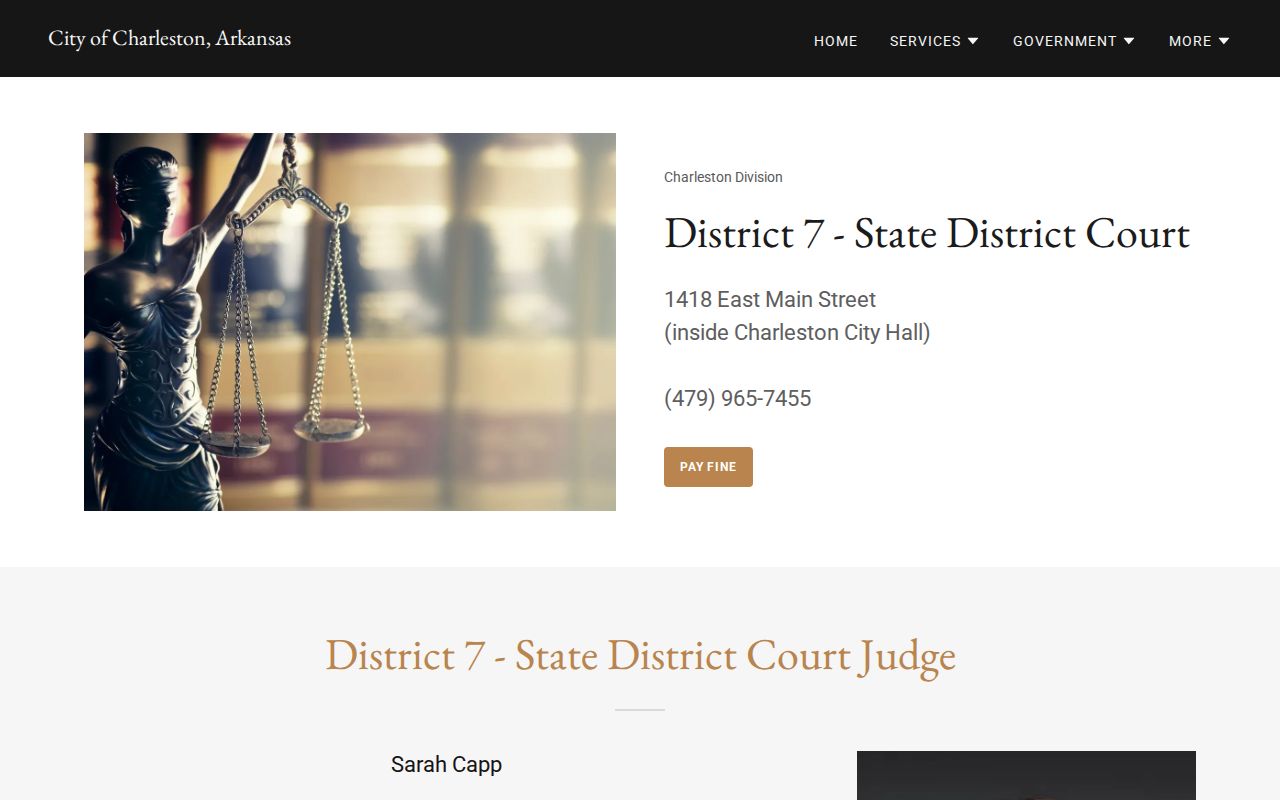
Charleston's court information is specific. The city district-court page identifies Sarah Capp as the 7th Judicial State District Court Judge in Franklin and Johnson Counties, with departments including Charleston, Ozark, Altus, Clarksville, Coal Hill, and Lamar. The police page says fines assessed through Franklin County District Court, Charleston Division can be paid online and gives (479) 965-7455 for district-court clerk questions.
The assigned court capture comes from Charleston's district court page, which is the local source for the judge and department routing used below.
| Court Name | Franklin County District Court, Charleston Division, part of the 7th Judicial State District Court. |
|---|---|
| Case Types Heard | Traffic, misdemeanors, local ordinance matters, state-law violations, and preliminary felony matters tied to the Charleston area. |
| Case Lookup Channel | Charleston district-court clerk at (479) 965-7455, Search ARCourts when a public docket is available, and Arkansas Online Court Payment for eligible fines. |
| What the Docket Shows | Case number, party name, charge or violation, settings, filings, payment entries, plea or disposition, and other public docket activity. |
| Copies & Fees | Police incident reports are listed at $10 per report; court-copy fees were not located and should be verified with the district-court clerk. |
Fines Through Arkansas Online Court Payment
Charleston's police page says fines assessed through Franklin County District Court, Charleston Division can now be paid online. The statewide court-payment portal is a payment route for eligible citations or fines, not a substitute for a full case-record search. A payment screen may confirm that a payable matter exists, but the underlying docket, disposition, and court history should still be checked through the court or Search ARCourts.
This distinction matters for record checks. Paying a fine can close or update a court obligation, while a docket shows the procedural history of the case. If a person is trying to understand whether a Charleston citation became a conviction, whether a warrant issued after missed court, or whether a disposition has posted, the clerk or docket is the better source than the payment portal alone.
Judge Sarah Capp's District Departments
The Charleston District Court page names Judge Sarah Capp and lists a multi-department district structure covering Franklin and Johnson Counties. For Charleston users, the practical point is that the court is local but not isolated. The same district-court structure also includes Ozark and Altus in Franklin County, along with Clarksville, Coal Hill, and Lamar in Johnson County.
Department names can appear in searches, notices, and payment records. A Charleston matter should be traced by court location, case number, party details, and the issuing department rather than by judge name alone. When a record is tied to the Charleston Division, the clerk phone listed in the research is (479) 965-7455.
How Charleston Records Reach the County
A Charleston police event may remain a city incident report, become a county jail booking, produce a district-court case, or move into circuit court depending on the facts. A report copy starts at Charleston Police. A current custody question moves to the county roster or sheriff. A citation or misdemeanor usually routes to Franklin County District Court, Charleston Division. A felony-level prosecution routes to the Circuit Clerk.
Record flow: Charleston Police Department › Franklin County District or Circuit Court › Arkansas Crime Information Center / Arkansas State Police repository
Once a case reaches disposition, repository records can update through state reporting channels. Gaps are possible when a booking does not become a charge, a charge is dismissed, a disposition is delayed, or a sealed case is removed from public access.
Report Copies vs. Court Files
A Charleston report copy and a Charleston court file answer different questions. The police report documents what officers recorded about an incident or arrest. It can include narrative, location, parties, offense classification, and investigative details, though some information may be redacted. The court file documents what prosecutors or the court filed, what hearings occurred, and how the case ended.
If the goal is to understand why police responded, begin with Charleston Police. If the goal is to confirm charge status, plea, disposition, fine, warrant, or sealing status, use the court. If the goal is an official statewide criminal-history review of oneself, use the Arkansas State Police process rather than a city report or public docket alone.
Charleston Record Access Rules
Charleston Police and Charleston district-court records are public only to the extent Arkansas law allows. Open records can be requested, but active investigations, juvenile information, victim details, sealed cases, and other exempt information may be withheld or redacted. Repository criminal-history information follows ACIC and Arkansas State Police dissemination rules that are separate from local police report access.
Key Statutes:
Arkansas Freedom of Information Act of 1967, Ark. Code § 25-19-101 et seq. - provides inspection and copying rights for public records unless a statutory exemption applies.
Ark. Code § 25-19-105(b)(6) - protects undisclosed law-enforcement investigation material connected to suspected criminal activity.
Ark. Code §§ 12-12-1008 and 12-12-1009 - set rules for criminal-history dissemination and conviction-information release.
Ark. Code § 12-12-1013 - allows personal review and challenge of criminal-history information after positive identity verification.
Ark. Code § 16-90-1401 et seq. - governs Arkansas sealing procedure, eligibility, release, and effect.